IDENTITY
Authenticate twice
Access enforces the application policy at the edge. The Worker still verifies the assertion signature, issuer, and application audience before serving an asset or API response.
Security
Fleet is an operator tool with meaningful authority. Its design keeps Cloudflare credentials out of browser JavaScript, constrains every proxied endpoint, and treats a mutation as a reviewed and verified state transition.
Security principles
IDENTITY
Access enforces the application policy at the edge. The Worker still verifies the assertion signature, issuer, and application audience before serving an asset or API response.
CAPABILITY
The hosted proxy accepts only Fleet's inventory and supported-write shapes. Account identifiers are fixed by configuration, and zone writes require ownership verification.
MUTATION
Every supported write depends on a fresh read and displays targets, before and after values, methods, endpoints, and payloads before execution.
Human checkpoint
A confirmation is rebuilt from live state and cannot execute until the operator checks the explicit review acknowledgement. The screenshot uses only synthetic .example data.
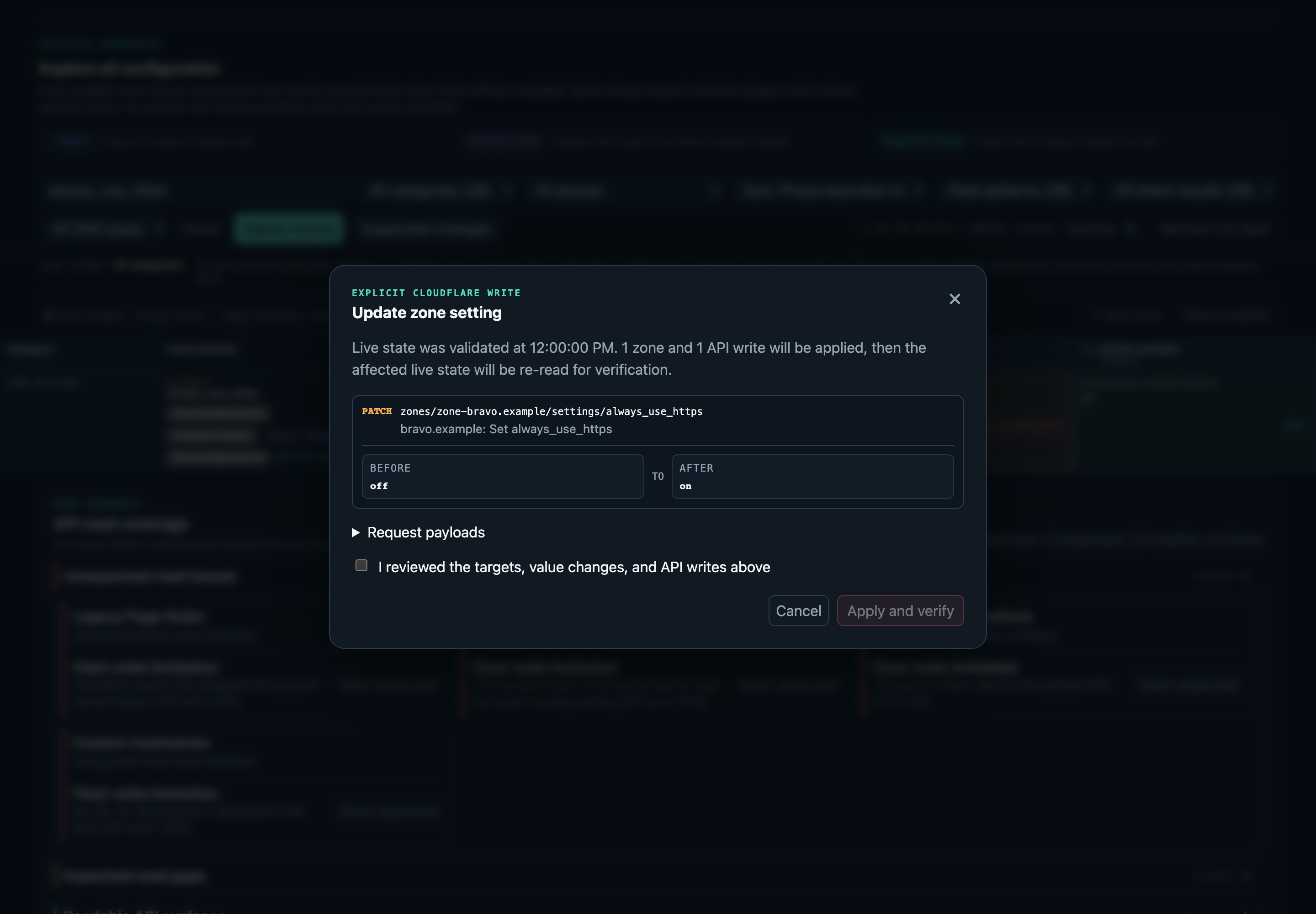
Trust boundaries
| Layer | Receives | Authority | Primary controls |
|---|---|---|---|
| Browser application | Rendered inventory, intent, activity, read-only flag, and a backend location or local session capability | Can request allowed backend operations but has no Cloudflare credential | Same-origin transport, no remote scripts, no credential persistence, explicit confirmation |
| Cloudflare Access | User identity and application policy | Allows or denies access to the hosted hostname | Identity provider, Allow policy, application session, edge enforcement |
| Hosted Worker | Access assertion, account boundary, encrypted API token, D1 binding, read-only mode | Can serve Fleet, persist Fleet documents, and call allowlisted Cloudflare API shapes | JWT verification, same-origin mutation check, bounded bodies and duration, path allowlists, and zone ownership checks |
| Local broker | API token, account ID, random session secret, private runtime and state paths | Equivalent Fleet reads and writes for one local session | Loopback binding, random capability, origin checks, private file modes, liveness-bound cleanup |
| Local CLI or MCP process | API token, account ID, complete intent documents, bounded change requests, planning digests, and explicit state paths | Can audit, persist intent, align supported drift, execute bounded direct changes, inspect activity, and perform guarded undo | Named operations, no raw API passthrough, revision and digest binding, fresh replanning, drift guards, throttle-aware reads, serialized writes, and protocol confirmation for MCP |
| Cloudflare D1 or local state | Inventory snapshots, desired state, acknowledgements, and operation journal | Persists configuration and operation evidence but no API token | Schema validation, account scoping, revisions, transactions or atomic file locks |
The Worker expects the Cloudflare API token only as a secret binding. Wrangler variables hold the account ID, D1 binding, Access issuer and audience, read-only flag, and validated operator policy, but never the credential. Static assets are built from the browser dependency graph and pass through the Worker before they are served.
For production requests, missing or invalid Access assertions fail closed. The implementation uses the assertion header recommended by Cloudflare and verifies the signing key, issuer, and audience through jose. Cloudflare explains why the origin must validate the token in Validate JWTs.
The Cloudflare proxy rejects paths outside its read and write allowlists before attaching the secret. It refuses upstream redirects, bounds request bodies and upstream duration, scopes account reads to the configured account, and confirms zone ownership before forwarding a zone write. The account read allowlist includes only the email-address inventory plus Workers custom domains and Pages projects required to detect alias-zone attachments. Setting FLEET_READ_ONLY=true rejects Cloudflare writes plus intent and activity mutations at the backend, not just in the interface.
The named Worker backend commands are separate from the raw proxy allowlist. They derive account-scoped configuration and log reads from one validated Worker identity, bounded time windows and evidence pages, and optional explicit route zones. The only Cloudflare mutation they derive is an exact schedules PUT, guarded by the reviewed digest, live deployment and schedule state, lock, journal, and verification. Read-only mode also rejects incident capture, verification persistence, and schedule intent saves.
Logs expose only allowlisted invocation identifiers, timestamps, event types, outcomes, versions, Cron expressions, HTTP statuses, and fixed known error signatures. Request headers, cookies, Access assertions, bodies, binding values, full source, and arbitrary error text are excluded. This is narrow projection, not a guarantee that unrestricted text could be perfectly redacted. The sanitized console-event fixture reproduces an upstream Observability MCP schema assumption without credentials or request payloads; Fleet tolerates the missing outcome and excludes that record from invocation counts.
Stored incident reports and operator-authored owner/reconciliation fields still contain private infrastructure context. Keep them with the private state profile and D1 backups, never in a public screenshot or repository. A saved configuration owner is descriptive authority, not permission for Fleet to edit arbitrary paths.
A normal local launch binds a temporary broker only to 127.0.0.1 on a random port. The token moves into the broker through a mode-restricted startup file that is consumed before readiness. The browser receives a random, timing-safe session capability in its generated bootstrap script. Requests also enforce the expected origin and same-site browser context.
The launcher opens the regular browser profile without a DevTools port or weakened cross-origin security. Debug mode is deliberately different: it uses a disposable profile, permits direct browser-to-Cloudflare traffic, and exposes a loopback DevTools endpoint. Do not browse unrelated sites in that debug window.
Local state and cache records contain the account configuration shown by Fleet. They are sensitive even though they contain no API token. Keep per-user state and policy files private, protect workstation backups, and use an explicit state path when separating accounts.
The CLI and MCP server are direct local processes, not browser clients. They inherit the API token and account identifier, so the process, its parent agent, and the host environment can exercise every Cloudflare permission granted to that token. Run them only for trusted local clients and keep secrets out of tracked or shared MCP configuration.
The MCP transport is stdio-only and opens no network listener. Tool inputs and outputs never include the API token, protocol frames stay on stdout, and diagnostics stay on stderr. Its named tools expose redacted runtime diagnosis, audit, typed canonical alias and hostname-scoped rate-limit policy descriptions, complete intent persistence, intent alignment, single and batched bounded direct changes, activity, and guarded undo without accepting arbitrary Cloudflare methods or paths. Tool-specific structured output schemas are paired with serialized JSON text for compatibility.
The CLI apply commands are intentionally noninteractive: the calling workflow must present the full plan and obtain operator approval before supplying its digest. MCP apply adds protocol-level input elicitation. Planning binds the canonical request and ordered payloads. Authenticated, method-bound, short-lived request state binds the account, exact request fingerprint, digest, required review-field count, and approval mode. Single-change elicitation presents compact operation deltas one field at a time and requires every field to be approved. Explicit alignment and direct-change batches split compact operation reviews into bounded required fields. Each review field accepts an acknowledgement or refusal; only the separate final field accepts whole-batch approval. Acknowledgements never authorize writes. Missing pages, extra fields, wrong decision types, cancellation, or a missing final approval prevent execution. The final field includes the plan digest, validation time, and scope totals. The formatter budgets the complete prompt for a reference terminal layout; clients with smaller viewports may require resizing or CLI/dashboard review. The shared service must produce the same fresh digest under the write lock in either mode. Batch preparation composes reads and blocks the complete plan if a member is blocked or two members target the same or nested API path. Intent persistence additionally requires the current account and revision. Guarded undo requires a reversible verified entry, rejects an existing undo, compares fresh live state with recorded verification evidence before review, and checks it again before inverse execution. A short-lived alignment baseline cache is accepted only for the same intent revision, and every preparation still rereads fleet membership and the selected live surfaces. HTTP 429 responses delay bounded GET retries according to Retry-After; an exhausted throttle fails the inventory operation, and mutation requests are never automatically retried.
Scope the Cloudflare API token to the minimum accounts, zones, and permissions required for the intended workflow. The getting-started guide maps common workflows to permission groups. Fleet's proxy and review model add controls, but the underlying token remains the ultimate Cloudflare capability.
Do not publish state.json, fleet-policy.json, wrangler.jsonc, .dev.vars*, .env*, Playwright traces, live screenshots, audit reports, or D1 exports. Those artifacts can contain account identifiers, domains, configuration, intended state, operation evidence, or secrets. State and policy default outside the source and package trees, checkout-local operator files are ignored, and npm run check:publication rejects the operator file names from a publication tree.
The committed product screenshots are generated through the local deterministic fixture. They contain only reserved .example hostnames, documentation IP addresses, synthetic settings, and a literal fake API token that never leaves the test broker.
Do not open a public issue for a suspected vulnerability. Follow the private reporting instructions in SECURITY.md and include the affected boundary, reproduction steps, impact, and any proposed mitigation. Do not include live API tokens or private fleet data.
Safe first deploy
Validate Access, account scope, and inventory before opting into writes.